 5 months ago

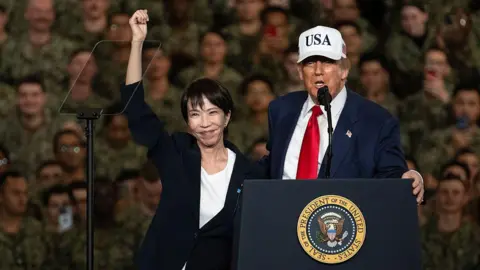 Getty Images
Sanae Takaichi is one of the first allied leaders to meet with Trump since the Iran war broke out
Japan's Prime Minister Sanae Takaichi is on her way to what she expects will be a "very difficult" meeting with US leader Donald Trump, days after his calls for allies to help secure the war-stricken Strait of Hormuz went largely unanswered.
Takaichi told parliament hours before her departure that she would "do everything to maximise [Japan's] national interest".
The three-day visit to Washington was a chance to talk trade and deepen the US-Japan alliance ahead of Trump's diplomatic trip to China - which has now been postponed because of the war.
But now it is the topic of the war that will likely overshadow the meeting, which is shaping up to be a test of Takaichi's friendship with Trump.
The trip was scheduled back in October, a week after Takaichi took office, when Tokyo rolled out the red carpet for Trump and the two leaders heaped compliments on each other, heralding a new "golden age" in bilateral ties.
As of a few weeks ago, the upcoming meeting looked set to be a success, with Takaichi "fresh off a dominant election victory and with a new round of investment projects in the US", Emma Chanlett-Avery, director for political and security affairs at the Asia Society Policy Institute, told the BBC.
But while Takaichi "had intended to build on the warmth of her first meeting with Trump and press upon him Japan's concerns about Chinese aggression ahead of Trump's [then scheduled] meeting with Xi", recent events have complicated things, said Chanlett-Avery.
Earlier this week, in a post on his Truth Social platform, Trump posted a request calling for some countries to help secure the vital strait.
He had pointed to Japan's and other Asian economies' dependence on fuel from the Middle East as reason for them to get involved.
"We get less than 1% of our oil from the [Strait of Hormuz] and some countries get much more... We want them to come and help us," he said.
But after receiving a lukewarm response, Trump retracted his request, saying in a post that the US did "NOT NEED THE HELP OF ANYONE!".
Takaichi had acknowledged the challenges she faced, saying before her departure from Japan on Wednesday that she faced a "difficult trip".
"I want to engage in substantial discussions based on Japan's point of view and our way of thinking," Takaichi told reporters. "The top priority is the early de-escalation of the situation."
What might Trump ask for?
"No one knows, however, what exactly Trump is going to demand, and whether [Takaichi] will really have the guts to decline on the spot," said Koichi Nakano, a political scientist at Tokyo's Sophia University.
Analysts add that it would be difficult for Takaichi to respond with a flat refusal if Trump up the issue of assistance in the strait during their meeting, given that nearly 95% of the oil Japan uses flows through the strait.
Another issue with Trump potentially demanding military intervention from Tokyo is that Japan is constrained by the pacifist constitution it adopted after World War Two, which bars the country from using force to resolve conflicts except in cases of self-defence.
Direct military assistance would also be deeply unpopular among the Japanese people, with a recent poll by newspaper The Asahi Shimbun showing 82% of voters disapprove of the war.
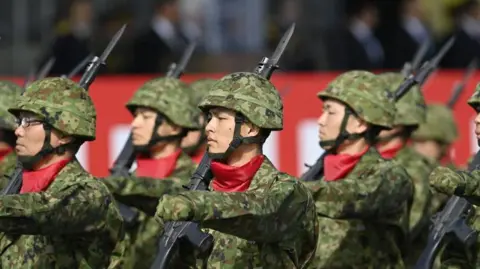 Getty Images
Japan is constrained by the pacifist constitution it adopted after World War Two
What else might the leaders talk about?
Takaichi will inevitably bring up the topic of China, which remains Japan's "biggest strategic challenge", says Sheila Smith of the US-based Council on Foreign Relations.
Ties between Beijing and Tokyo have plummeted since November, when Takaichi appeared to suggest that Japan would activate its self-defence force in the event of an attack on Taiwan.
China claims self-governed Taiwan as its own and has not ruled out the use of force to "reunify" with it one day.
Takaichi has neither apologised nor retracted her remarks.
Takaichi and Trump are also expected to discuss Japan's participation in the US' Golden Dome missile defence system, according to Japanese media reports last week.
An initial sum of $25bn (£18.7bn) has been earmarked for the project, which is inspired by the Iron Dome that Israel has been using to intercept rockets and missiles since 2011.
But what comes out of the meeting "all depends on Trump's mood when the two meet", according to Sophia University's Nakano.
"The world will be gauging Trump's mood," he says, "though that can only last for several hours perhaps, so not much of an indicator of anything."
The president, he adds, is "known to have a transactional understanding of alliance relationships in general".
And of course, there is the topic of trade.
With Japan's domestic economy struggling to cope with a rising inflation, a weak yen and sluggish consumer spending, securing a stable economic partnership with US is especially vital.
And so Takaichi is likely to portray herself as a leader who Trump can get along and do business with.
Mireya Solís, from the Brookings Institution, who specialises in Japanese foreign economic policy, points out that Tokyo has strived to be the first among Washington's trade partners to make good on commitments struck in exchange for tariff reductions.
In February, Trump announced the first batch of projects under Japan's $550bn investment pledge that won it some tax relief - with the US lowering tariffs on auto imports from Japan from 27.5% to 15%.
Takaichi is now expected to announce additional projects worth about $100bn when she meets Trump.
But the visit also comes just days after Washington initiated an unfair trade practice investigation into Japan and other countries - which could lead to new tariffs being imposed.
Japan will likely want to make sure it is not walking away from the meeting with less favourable terms than had previously been agreed.