 5 months ago
Most social media companies claim they require their sites’ users to be at least 13 years old. But no surprise, younger kids use the sites, too. In fact, a majority of preteens say they do — and some have problems as a result. That’s the finding of emerging data from a new study.
Courtney Blackwell works at Northwestern University’s Feinberg School of Medicine in Chicago, Ill. Her work focuses on how kids’ social world affects their mental well-being. One of her team’s projects looks at social media use among 8- to 12-year-olds. Its data come from an ongoing National Institutes of Health program called ECHO. That’s short for Environmental Influences on Child Health Outcomes. This project regularly surveys thousands of U.S. children.
More than two-thirds of the 4,700 preteens it’s been surveying report using social media, Blackwell’s team finds. That’s almost twice as many as reported doing so five years earlier.
On average, preteens spent 1.57 hours per day on social media. However, Blackwell points out, “there’s lots of variability.” Some kids were on these sites more than four hours per day.
YouTube was the most popular social media site for the roughly 3,100 preteens who said they used social media. More than eight in every 10 of them reported being on it. Almost one in every four had used TikTok and Facebook.
Preteens gave entertainment and fun as their top reason for using social media. More than half said they turn to it to learn new things or connect with friends and family. “There are some really positive ways they’re using it,” Blackwell says. “So it’s not just this negative platform.”
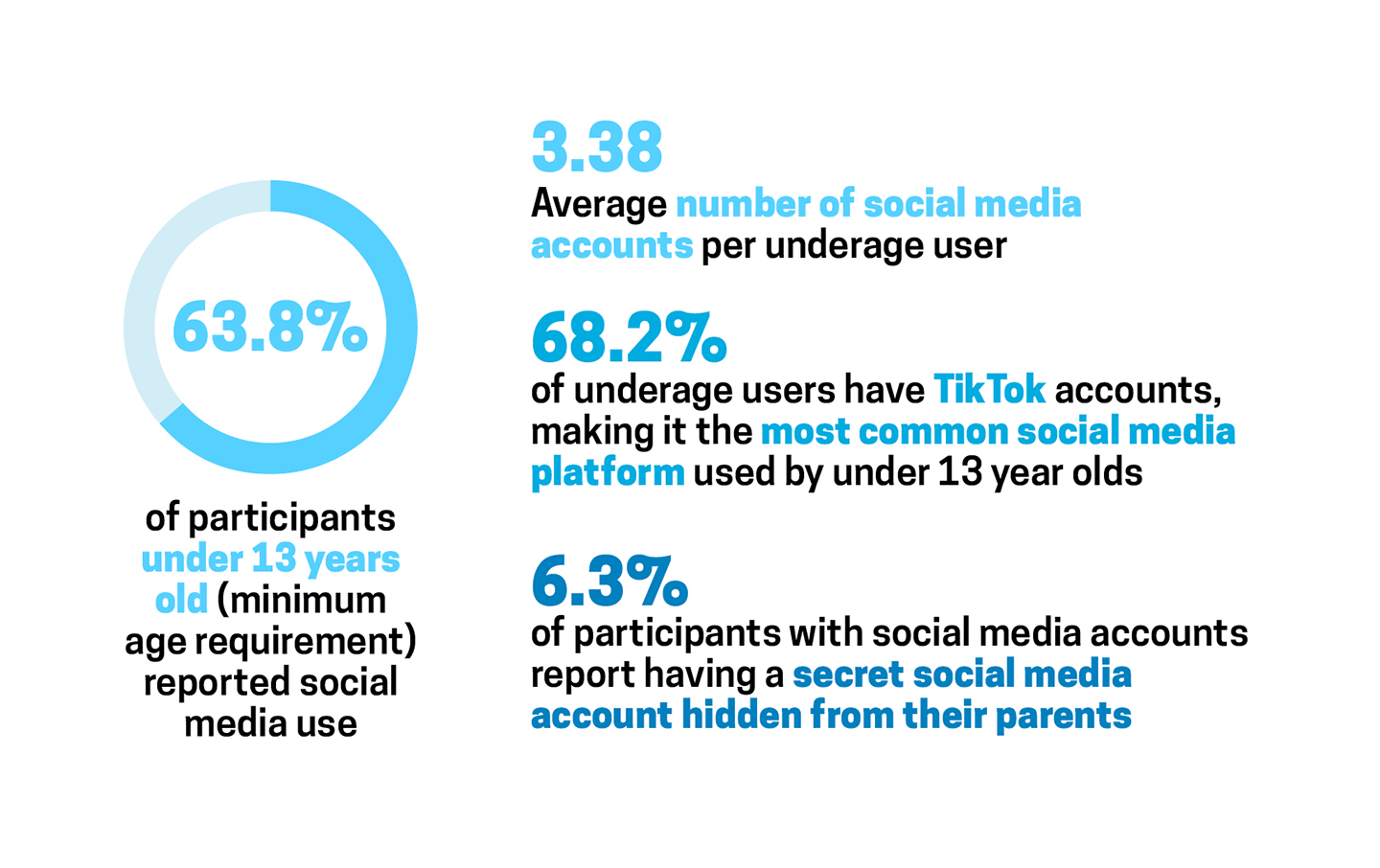 You’re supposed to be at least 13 years old to use TikTok and other social media. But in a study, nearly two-thirds of kids younger than that say they have accounts anyway.Jacqueline Hur
Roughly one-third use social media for things such as calming down when stressed, forgetting about problems or avoiding things they need to do.
There is one clear downside to some social-media use. About one in 10 underage kids reported having been cyberbullied on it, Blackwell’s group notes.
A 2022 analysis by different researchers found a similar share of 11-and 12-year olds had been targets of cyberbullying.
“Being bullied in general can lead to poor mental health,” says that study’s lead author, Jason Nagata. He’s a doctor who specializes in teen health at the University of California, San Francisco. Online bullying, he adds, also may be harder to stop than the face-to-face type. People can bully others from far away or even anonymously. Those data came from an ongoing study known as ABCD (for Adolescent Brain Cognitive Development).
Too much of a (sometimes) good thing?
Blackwell’s team wondered whether and how social media use might sometimes be unhealthy. To gauge that, they looked at answers to nine questions. For example: Did kids try — unsuccessfully — to spend less time on social media? Did they regularly lie about how much time they spent on it? And did they use social media to escape negative feelings?
Roughly 9 percent of the social media users said yes to more than half of the questions. “I was not expecting that many kids,” Blackwell says, at least not at so young an age.
Kids with certain mental-health issues — such as anxiety or depression — or ADHD were more likely to fall into that group. In contrast, kids who didn’t start using social media until they were teens were less likely to have said “yes” to so many questions.
Blackwell’s team shared its findings during a webinar on February 11. The scientists plan to publish those data in the coming months.
 Roughly one in 11 preteens may use social media in ways that can interfere with their relationships and normal activities, a new study finds. Thawatchai Chawong/iStock/Getty Images Plus
Use social media carefully
Many studies have explored screen use by very young children or by teens. Fewer have looked at this “middle group” of 8- to 12-year-olds, notes Kate Blocker. She’s a child-development specialist in Huntsville, Ala. There she heads up research for Children and Screens, a New York City-based nonprofit.
“While social media can be a place for entertainment and connection, over one-third of kids are also using it as a ‘digital escape’ to avoid tasks or to forget about personal problems,” she observes. That suggests some kids may be harmed on platforms meant for adults.
“We need more research, better designs and stronger safeguards to support children’s well-being online and offline,” she concludes.
Do you have a science question? We can help!
Submit your question here, and we might answer it an upcoming issue of Science News Explores
“Screens and social media aren’t inherently bad or good,” Nagata adds. So, he suggests, think about how social media makes you feel. Try to maximize the good aspects and minimize the bad. If you think social media is interfering with other things in your life, set limits. And maybe seek help from parents, teachers or a trusted adult.
Another tip from Nagata: Have a purpose when you go online. Once you finish that, sign off. Plan activities beyond social media, too. You’re less likely to feel bad about “missing out” online if you’re playing sports or doing other fun things with friends, he notes.
Power Words
More About Power WordsADHD: Short for attention deficit hyperactivity disorder. This condition is characterized by an ongoing pattern of being impulsive (acting without thinking, for instance), inattentive (have trouble staying on task) or hyperactive (fidgeting excessively or seeming overly restless and talkative). Someone can have any or all of these symptoms — and often at a level that tends to get in the way of their functioning effectively.
anxiety: A nervous reaction to events causing excessive uneasiness and apprehension. People with anxiety may even develop panic attacks.
average: (in science) A term for the arithmetic mean, which is the sum of a group of numbers that is then divided by the size of the group.
bullying: (v. to bully) A group of repeated behaviors that are mean-spirited. They can include teasing, spreading rumors about someone, saying hurtful things to someone and intentionally leaving someone out of groups or activities. Sometimes bullying can include attacks using violence (such as hitting), threats of violence, yelling at someone or abusing someone with violent language. Much bullying takes place in person. But it also may occur online, through emails or via text messages. Newer examples including making fake profiles of people on websites or posting embarrassing photos or videos on social media.
data: Facts and/or statistics collected together for analysis but not necessarily organized in a way that gives them meaning. For digital information (the type stored by computers), those data typically are numbers stored in a binary code, portrayed as strings of zeros and ones.
depression: A low spot, such as in a field or the surface of a rock. (in medicine) A mental illness characterized by persistent sadness and apathy. Although these feelings can be triggered by events, such as the death of a loved one or the move to a new city, that isn’t typically considered an “illness” — unless the symptoms are prolonged and harm an individual’s ability to perform normal daily tasks (such as working, sleeping or interacting with others). People suffering from depression often feel they lack the energy needed to get anything done. They may have difficulty concentrating on things or showing an interest in normal events. Many times, these feelings seem to be triggered by nothing; they can appear out of nowhere.
development: (in biology) The growth of an organism from conception through adulthood, often undergoing changes in chemistry, size and sometimes even shape. (in economics and social sciences) The conversion of land from its natural state into another so that it can be used for housing, agriculture, or resource development. (in engineering) The growth or change of something from an idea to a prototype.
digital: (in computer science and engineering) An adjective indicating that something has been developed numerically on a computer or on some other electronic device, based on a binary system (where all numbers are displayed using a series of only zeros and ones).
environment: The sum of all of the things that exist around some organism or the process and the condition those things create. Environment may refer to the weather and ecosystem in which some animal lives, or, perhaps, the temperature and humidity (or even the placement of things in the vicinity of an item of interest).
focus: (in behavior) To look or concentrate intently on some particular point or thing.
gauge: A device to measure the size or volume of something. For instance, tide gauges track the ever-changing height of coastal water levels throughout the day. Or any system or event that can be used to estimate the size or magnitude of something else. (v. to gauge) The act of measuring or estimating the size of something.
maximize: (in psychology) A strategy that some people employ in which they consider every possible option to find the best one. The alternative involves looking at just enough options to find one that is good enough.
media: A term for the ways information is delivered and shared within a society. It encompasses not only the traditional media — newspapers, magazines, radio and television — but also digital outlets, such as Twitter, Facebook, Instagram, TikTok and WhatsApp. The newer, digital media are sometimes referred to as social media. The singular form of this term is medium.
mental health: A term for someone’s emotional, psychological and social well-being. It refers to how people behave on their own and how they interact with others. It includes how people make choices, handle stress and manage fear or anxiety. Poor mental health can be triggered by disease or might reflect a short-term response to life’s challenges. It can occur in people of any age, from babies to the elderly.
National Institutes of Health: (or NIH) This is the largest biomedical research organization in the world. A part of the U.S. government, it consists many separate institutes — such as the National Cancer Institute and the National Human Genome Research Institute — including some additional centers. Most are located on a 300 acre facility in Bethesda, Md., a campus containing 75 buildings.
social media: Digital media that allow people to connect with each other (often anonymously) and to share information. Examples include Twitter, Facebook, Instagram, TikTok and WhatsApp.
stress: (in biology) A factor — such as unusual temperatures, movements, moisture or pollution — that affects the health of a species or ecosystem. (in psychology) A mental, physical, emotional or behavioral reaction to an event or circumstance (stressor) that disturbs a person or animal’s usual state of being or places increased demands on a person or animal; psychological stress can be either positive or negative. (in physics) Pressure or tension exerted on a material object.
survey: To view, examine, measure or evaluate something, often land or broad aspects of a landscape. (with people) To ask questions that glean data on the opinions, practices (such as dining or sleeping habits), knowledge or skills of a broad range of people. Researchers select the number and types of people questioned in hopes that the answers these individuals give will be representative of others who are their age, belong to the same ethnic group or live in the same region. (n.) The list of questions that will be offered to glean those data.
webinar: A presentation of some type, led by one or more speakers, and conducted live over the internet. Sometimes attendees can ask questions. Other times, it may be just a one-way sharing of information by the presenters.
Citations
Webinar: C. Blackwell. The kids are(n’t) alright: The role of social media in youth mental health. ECHO Discovery webinar, February 11, 2026.
Journal: J. Nagata et al. Prevalence and patterns of social media use in early adolescents. Academic Pediatrics. Vol. 25, May–June 2025, 102784. doi: 10.1016/j.acap.2025.102784.
Journal: J. Nagata et al. Social epidemiology of early adolescent cyberbullying in the United States. Academic Pediatrics. Vol. 22, November–December 2022, p. 1287. doi: 10.1016/j.acap.2022.07.003.
Report: V. Rideout et al. The Common Sense Census: Media use by tweens and teens, 2021. Common Sense Media, San Francisco, Calif., 64 pp.

Kathiann Kowalski reports on all sorts of cutting-edge science. Previously, she practiced law with a large firm. Kathi enjoys hiking, sewing and reading. She also enjoys travel, especially family adventures and beach trips.